- Customer group: Guest
-


- Home

- Details
- More images
Products description
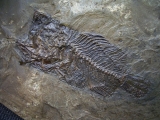
This fossilized bird feather comes from the Eocene deposits of the world-famous Messel Pit.
Messel fossils are highly sought-after collector's items. The site has been inaccessible for many years.
This piece comes from an old collection; it was discovered in the 1970s.
As is typical for Messel fossils, this specimen was prepared using the resin transfer method. This is the only way to permanently preserve such fossils.
The Messel Pit is a UNESCO World Heritage Site, and no new finds have come onto the market for decades.
The feather is remarkably well-preserved and shows many details. It measures approximately 3 cm. The unbroken plate measures approximately 5 x 3.5 cm.
Fossilized feathers are very rare—they can only be preserved through extremely careful preparation.
An authentic, unaltered piece.
We only have this one – don't miss this opportunity.
ON HOLD
Feathers are among the most spectacular finds at the Messel Pit, as they offer insights into the vibrant colors of prehistoric times. Here are
the key facts:
1. Sensational Color Reconstruction
Fossils from Messel have revolutionized paleontology because, for the first time, researchers were able to scientifically prove the original
colors of prehistoric birds.
Melanosomes: Microscopic pigment molecules (melanosomes) have been preserved in the feathers.
Structural Colors: The arrangement of these melanosomes has shown that many birds 48 million years ago were iridescent (shimmering),
similar to modern starlings or hummingbirds. A famous example is a prehistoric bird whose plumage shone with a metallic blue hue.
2. Exceptional Preservation
Thanks to the oxygen-free conditions at the bottom of what was then Lake Messel, not only the skeleton but often the entire plumage
shadow was preserved.
Details: Individual feather barbs and barbules can often be seen under a microscope.
Preen gland: Fossilized fat from the preen gland, which the bird used to groom its plumage, was even found in one bird fossil – a rare
organic soft tissue find.
3. Diversity of Species
The Messel Pit is considered the world's most important site for Eocene bird fossils. Found there include:
Small birds with raptor-like beaks.
Related species of modern swifts and hummingbirds.
Extensive evidence for the early evolution of modern bird groups.
SOLD
Messel fossils are highly sought-after collector's items. The site has been inaccessible for many years.
This piece comes from an old collection; it was discovered in the 1970s.
As is typical for Messel fossils, this specimen was prepared using the resin transfer method. This is the only way to permanently preserve such fossils.
The Messel Pit is a UNESCO World Heritage Site, and no new finds have come onto the market for decades.
The feather is remarkably well-preserved and shows many details. It measures approximately 3 cm. The unbroken plate measures approximately 5 x 3.5 cm.
Fossilized feathers are very rare—they can only be preserved through extremely careful preparation.
An authentic, unaltered piece.
We only have this one – don't miss this opportunity.
ON HOLD
Feathers are among the most spectacular finds at the Messel Pit, as they offer insights into the vibrant colors of prehistoric times. Here are
the key facts:
1. Sensational Color Reconstruction
Fossils from Messel have revolutionized paleontology because, for the first time, researchers were able to scientifically prove the original
colors of prehistoric birds.
Melanosomes: Microscopic pigment molecules (melanosomes) have been preserved in the feathers.
Structural Colors: The arrangement of these melanosomes has shown that many birds 48 million years ago were iridescent (shimmering),
similar to modern starlings or hummingbirds. A famous example is a prehistoric bird whose plumage shone with a metallic blue hue.
2. Exceptional Preservation
Thanks to the oxygen-free conditions at the bottom of what was then Lake Messel, not only the skeleton but often the entire plumage
shadow was preserved.
Details: Individual feather barbs and barbules can often be seen under a microscope.
Preen gland: Fossilized fat from the preen gland, which the bird used to groom its plumage, was even found in one bird fossil – a rare
organic soft tissue find.
3. Diversity of Species
The Messel Pit is considered the world's most important site for Eocene bird fossils. Found there include:
Small birds with raptor-like beaks.
Related species of modern swifts and hummingbirds.
Extensive evidence for the early evolution of modern bird groups.
SOLD


Categories
Last viewed: