- Customer group: Guest
-


- Home

- Details
- More images
Products description
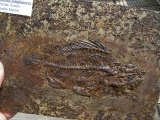
This perch Amphiperca multiformis comes from the Eocene deposits of the world-famous Messel Pit
in Germany,

Messel fossils are highly sought-after collector's items. The site has been inaccessible for many years.

This specimen comes from an old collection and was discovered in the 1970s.

As is typical for Messel fossils, this specimen was prepared using the resin transfer method. This is
the only way to permanently preserve such fossils.

The Messel Pit is a UNESCO World Heritage Site, and no new finds have come onto the market for decades.

The fish is remarkably well-preserved and shows many details. It measures approximately 7 cm. The unbroken
slab measures approximately 12 x 9 cm.

An authentic piece without any manipulation.

A rare opportunity!
The fossil Amphiperca multiformis is one of the best-known fish species from the UNESCO World Heritage Site
of Messel Pit. It is a perch-like predatory fish that lived approximately 47 to 48 million years ago during
the Middle Eocene.
Key characteristics and lifestyle
Appearance: Amphiperca is characterized by a stocky, high-backed body and a relatively large head with a
wide mouth.
Habitat: The fish inhabited the ancient Lake Messel, a deep, tropical maar lake. Its body shape suggests
that it was an agile ambush predator that hunted among aquatic plants near the shore.
Diet: As a predator, it fed on smaller fish and invertebrates.

Special Features of Fossil Preservation
Precision: Thanks to the oxygen-free conditions at the bottom of the lake, the fossils are exceptionally
well preserved. Often, not only skeletons but also soft tissue shadows, scales, and even stomach contents
are visible.
Transfer Method: Because the oil shale in which the fossils are found dries out and crumbles quickly in the
air, the pieces must be preserved using a special plastic transfer method (embedding in epoxy resin).
Rarity: Compared to other Messel fish such as Cyclurus, Amphiperca is less common.

SOLD


Categories
Last viewed: