- Customer group: Guest
-


- Home

- Details
- More images
Products description
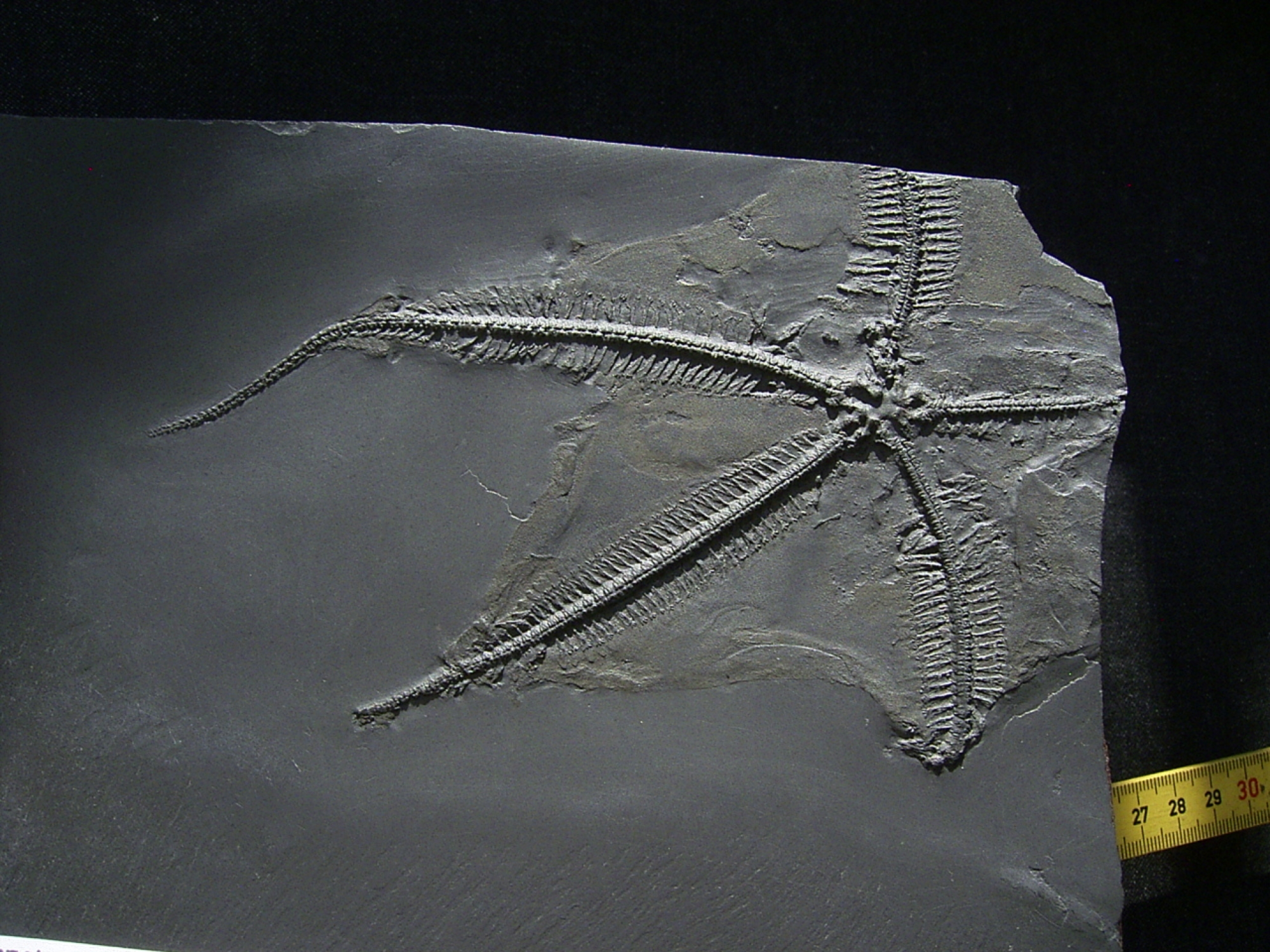
This is a fossil brittle star, Loriolaster mirabilis. It was found in the Lower Devonian deposits of Bundenbach
in Germany. This fossil is approximately 400 million years old.

The fossil is wonderfully preserved and rich in detail, and superbly prepared. It was a fairly large specimen,
the fossil measures approximately 14 x 9 cm. The stone is unbroken and measures approximately 18 x 14 cm.
There is absolutely no evidence of any manipulation of this rare collector's item!

Key characteristics of Loriolaster mirabilis:

Fossil: This is an extinct species, whose remains are limited to fossil slabs from the Devonian sea.
Location: The Hunsrueck Slate near Bundenbach is the primary location, making it a highly sought-after
collector's item.
Appearance (Fossil): The fossils often show a well-preserved, spread-out star, viewed from above (oral side),
sometimes together with other fossils.
Size: The fossils can reach a considerable size, sometimes with a span of over 15 cm on the slab.
Systematics: Although often called a "starfish," it belongs to the order Ophiuroidea (brittle stars).
General characteristics of brittle stars (to which Loriolaster belongs):
Closely related to starfish: Brittle stars are the closest relatives of starfish.
Movable arms: They move using their movable arms, without the tube feet (podia) of starfish.
Tooth plates: They have skeletal plates in their mouths that act like jaws and teeth to grind food.
No anus: The digestive tract is sac-like and lacks an anus; food is expelled.

In summary, Loriolaster mirabilis is a famous fossil that provides insights into the extinct marine
life of the Devonian period, particularly the fascinating group of brittle stars.

Extinct locality: The species is particularly well-known from the historical slate quarries of Bundenbach in the Hunsrueck, Germany. Since commercial mining there was discontinued in 1999, such specimens today only come from old collections.




Categories
Last viewed: